Picture a Sunday afternoon in Monaco. The air is thick with the smell of burning rubber and high-octane fuel. To the millions watching live and on TV, this is the moment of truth: a battle of raw instinct, adrenaline, and split-second reflexes.
Three of the fastest men on Earth, Max Verstappen, Lewis Hamilton, and Charles Leclerc, are strapped into their cockpits. But before the five red lights go out, the race has already been won.
It wasn’t decided on the asphalt; it was decided days earlier in a silent server room hundreds of miles away.

Left: Charles Leclerc | Middle: Lewis Hamilton | Right: Max Verstappen
From Burning Fuel to Burning Data
The rules of the game have fundamentally changed. For decades, Formula 1 engineering was defined by a simple loop: build a new part, test it on a private track, break it, and fix it. If Ferrari wanted to know if a new front wing worked, they simply drove it for 500 laps.
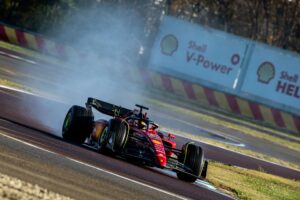
Ferrari tests on a wet Fiorano track
But in 2025, that luxury is gone. To level the playing field, the highest authority in the motorsport world, the Fédération Internationale de l’Automobile (FIA), enforced strict Cost Caps and a near-total ban on physical testing. Teams are now strictly limited on how many hours they can spend in a wind tunnel and are forbidden from running their current cars outside of race weekends.
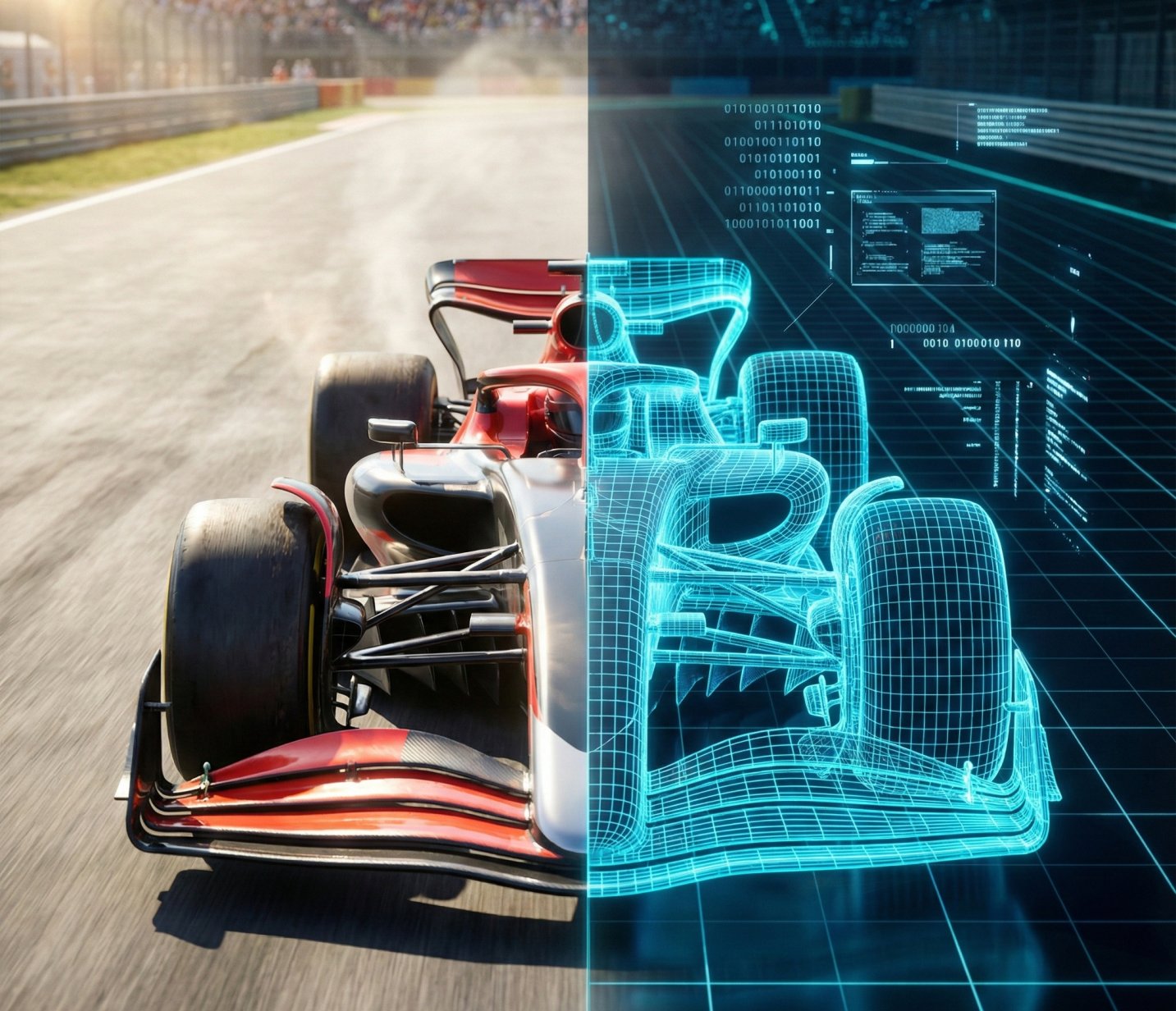
Deprived of the asphalt, engineers were forced to retreat to the cloud. They couldn’t build more physical prototypes, so they built a Digital Twin.
Hidden inside the Headquarters of Mercedes and Red Bull is a physics-perfect, virtual clone of the car. It is a mathematical mirror that replicates every bolt, sensor, and aerodynamic surface of the real machine. Instead of burning fuel, teams now burn data, running the ‘Ghost Car’ through billions of simulations to predict the future with terrifying accuracy.
The modern Grand Prix isn’t just a race of drivers; it is a war of code.
Build, Break, Repeat!
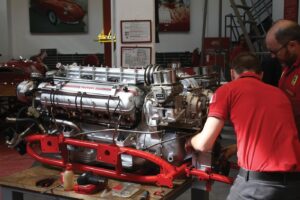
Mechanics working on a physical Ferrari engine
In the early 2000s, Formula 1 engineering was brute force. If Ferrari wanted to test a new engine part, they didn’t simulate it. They put Michael Schumacher in a car at their private track and had him drive until something exploded. It was simple, but expensive. Teams burned through hundreds of engines and millions of dollars just to test a single idea.
Hardware-in-the-Loop (HiL)
Today, because physical testing is banned, engineers invented a way to trick the car into thinking it’s racing. Imagine taking the car’s brain, the Electronic Control Unit (ECU) and plugging it into a supercomputer. They can run a “Virtual Grand Prix” 1,000 times a night without using a drop of gasoline.
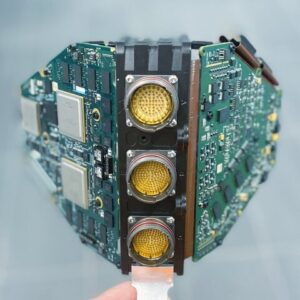
McLaren Applied TAG-320B (ECU)
The Physical Layer: Engineers take the actual “brain” of the car, the ECU and hydraulic systems, and mount them on a test rig or sometimes the entire chassis onto a suspension rig, to simulate the physical vibrations of the track.
The Virtual Layer: A supercomputer (often running on Oracle Cloud or AWS) feeds the ECU synthetic sensor data. It tells the engine: “You are at Monza, Turn 1, traveling 190mph, with a track temp of 40°C.”
The Loop: The physical engine “believes” it is racing. It accelerates to full power, the brakes get hot, and the hydraulics fire, all while the car is sitting still. The computer measures these physical reactions and updates the simulation in real-time.
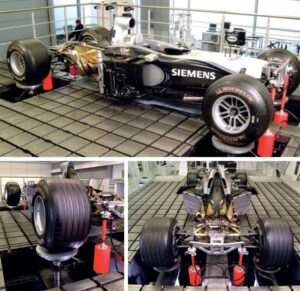
Formula 1 Racecar Hardware-in-Loop (HiL) Simulation
Enter AI: Building the “Ghost Car”
This is where Artificial Intelligence takes the wheel.
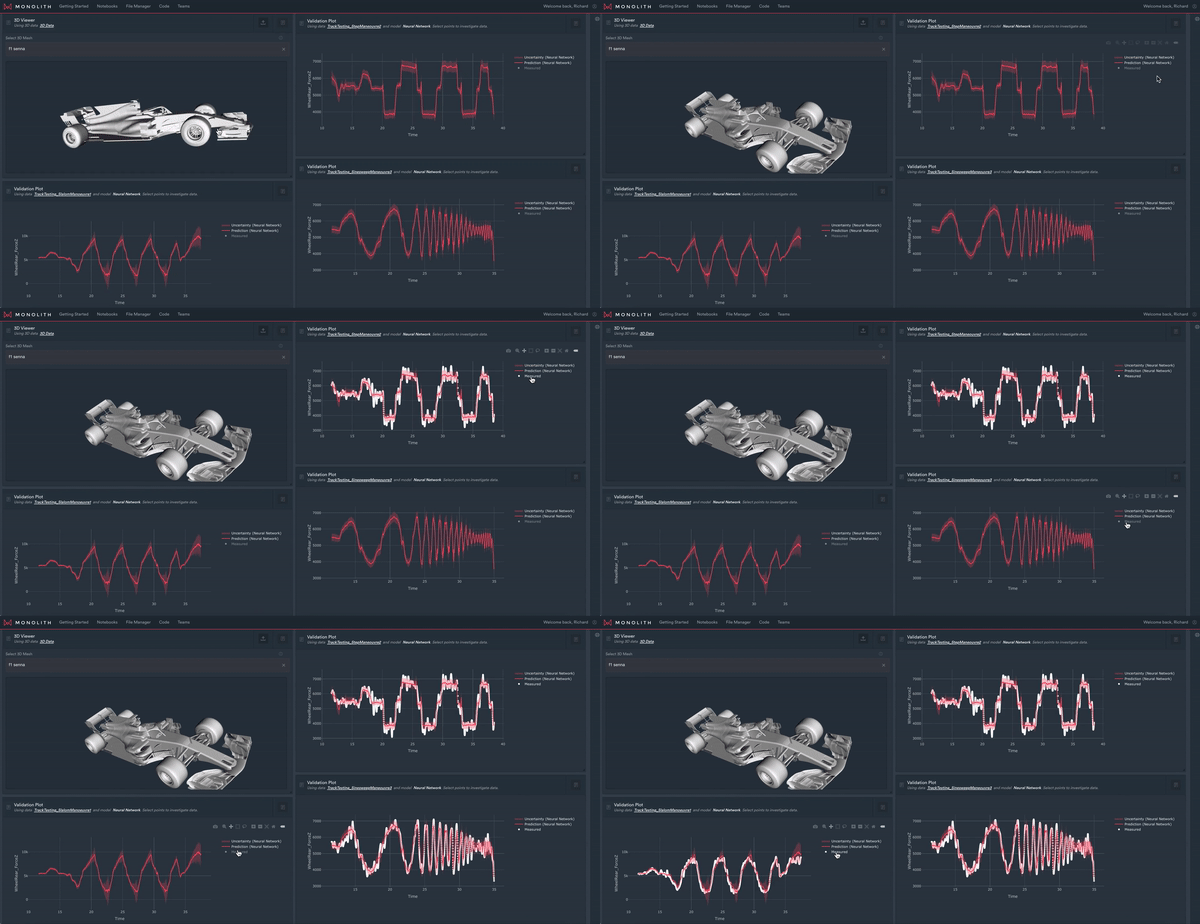
Running a simulation is easy. Making it accurate is hard. How do you know exactly how a tire will grip the road on Lap 45 if you can’t test it? Teams feed 10 years of historical data into Machine Learning models. The AI analyzes every rainy race, every crash, and every tire failure from the last decade to build a “Ghost Car.”
The Prediction: The AI doesn’t just guess; it learns. It tells the team: “Based on the cloud density and asphalt temperature, the soft tire will die on Lap 14, not Lap 18.”
The Strategy: Before the race starts, AI algorithms run billions of scenarios (Monte Carlo simulations). It plays out the race like Doctor Strange viewing 14 million futures, finding the one path where the team wins.
So when you hear a race engineer tell Max Verstappen, “Box now, box now,” it’s often not a human decision. It’s the AI realizing that in 98% of the simulations, stopping now leads to victory.
How AI in Formula 1 Strategy Predicted the Impossible
The Monza Miracle: When Math defied Physics
Theory is nice, but does it actually win races? The answer came in stunning fashion at the 2024 Italian Grand Prix.
Picture the scene of Monza, the “Temple of Speed.” Ferrari’s Charles Leclerc is leading his home race, but he is a sitting duck. Behind him, the two McLaren cars are on fresh tires, hunting him down at one second per lap.
To the human eye, the situation looked hopeless. Leclerc’s tires were 30 laps old and visibly tearing apart. Every commentator, and every rival strategist said the same thing: “He has to pit. If he stays out, the tire will explode at 200mph.” The McLaren strategists pitted their drivers, assuming Ferrari would have to do the same.
But back in the garage, Ferrari’s Digital Twin data told a different story. The simulator had run this exact scenario thousands of times overnight. It saw a hidden pattern that the human eye missed: “The Granulation Healing Phase” (how the tire heals itself after wearing down).
The simulation showed that if the driver could survive the “pain phase” (Laps 30-35), the rubber would actually clean itself up as the fuel load got lighter and track temperatures stabilized.
On Lap 40, Carlos Sainz (Leclerc’s teammate) radioed in: “The tires are coming back.” This human feedback confirmed the AI model. While McLaren panicked and pitted, Ferrari trusted the data. They ordered Leclerc to STAY OUT.
The world held its breath as the McLarens closed the gap… 5 seconds… 3 seconds… 2 seconds. But the math held. The tires didn’t explode; they stabilized exactly as predicted.
Leclerc crossed the finish line to win by a terrifyingly slim 2.6 seconds. It was hailed as a driver’s victory, but insiders knew the truth: It was a victory of confidence. The simulation had proven the tires would survive, giving the team the nerves of steel required to defy the laws of physics.
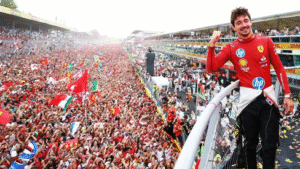
Charles Leclerc after winning the 2024 Italian Grand Prix, Monza
The Cautionary Tale: The 1.5kg Blind Spot
However, trusting the “Ghost Car” blindly can be dangerous. While the Digital Twin is a mathematical masterpiece, it is not a crystal ball. It is only as good as the parameters humans feed it. And in Formula 1, a 0.1% error in the code can lead to a catastrophic public failure.
The industry got a brutal reminder of this at the 2024 Belgian Grand Prix (Spa). Mercedes driver George Russell pulled off a shock victory using a bold “One-Stop” strategy, much like Ferrari did at Monza. The team’s Digital Twin had calculated that his hard tires would survive the distance without losing too much grip. Russell crossed the finish line first, celebrating a tactical masterclass.
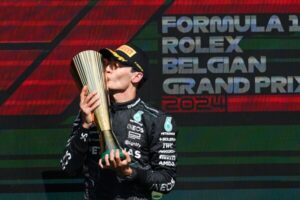
George Russell after winning the 2024 Belgian Grand Prix
But two hours later, the celebration turned to horror. The FIA weighed his car and found it was 1.5kg underweight. Russell was disqualified instantly. The win was stripped. How did a championship-winning team make such a rookie error? The answer lies in the gap between “Virtual Physics” and “Real Reality.”
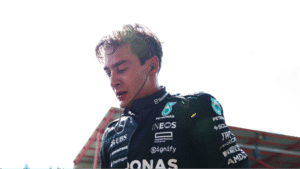
George Russell after getting disqualified
The Digital Twin successfully modeled the Thermal Degradation (how hot the tires get and how much grip they lose). It correctly predicted that Russell could keep up the pace. But the simulation underestimated the Physical Ablation (the sheer mass of rubber being scraped off the tire). Because Russell drove so aggressively on such old tires, he physically scraped off more rubber than the model predicted. The tires became too light, dragging the total car weight below the legal limit.
The computer optimized for speed, but it forgot to optimize for legality. The Digital Twin can simulate the race, but it cannot simulate the chaos of the real world with 100% perfection.
The Future: 2026 and The “Active” Era
As we look beyond the 2025 season, the role of the Digital Twin is about to change from “Advisor” to “Co-Pilot.” The upcoming 2026 regulations are introducing the biggest technical shift in a generation: Active Aerodynamics. For the first time, cars will have movable wings that drastically change shape mid-lap to reduce drag on straights and increase grip in corners. This adds a layer of complexity that is beyond human intuition.
A driver cannot manually adjust wing angles for every single corner while driving at 200 mph. The Digital Twin will likely pre-calculate the perfect aerodynamic profile for every meter of the track.
The line between the “Driver” and the “Machine” is blurring. The car on the track is becoming a physical puppet, dancing to a script written by the AI in the server room.
Formula 1 has always been a mirror of the automotive future. In the 1980s, it gave us traction control (systems that stop the car from skidding). In the 2010s, it gave us efficient hybrids (engines that turn braking energy into free speed).
The teams that win today are not the ones with the bravest drivers or the biggest wind tunnels. They are the ones with the most accurate code. The sport has shifted from a battle of burning fuel to a battle of burning data.
When the lights go out next Sunday, enjoy the noise. Enjoy the chaos. But remember that in the silence of a server room hundreds of miles away, the winner has likely already been decided.
Know more about relevant topics:
The “Butterfly” We Finally Caught: How AI Tamed Chaos: