
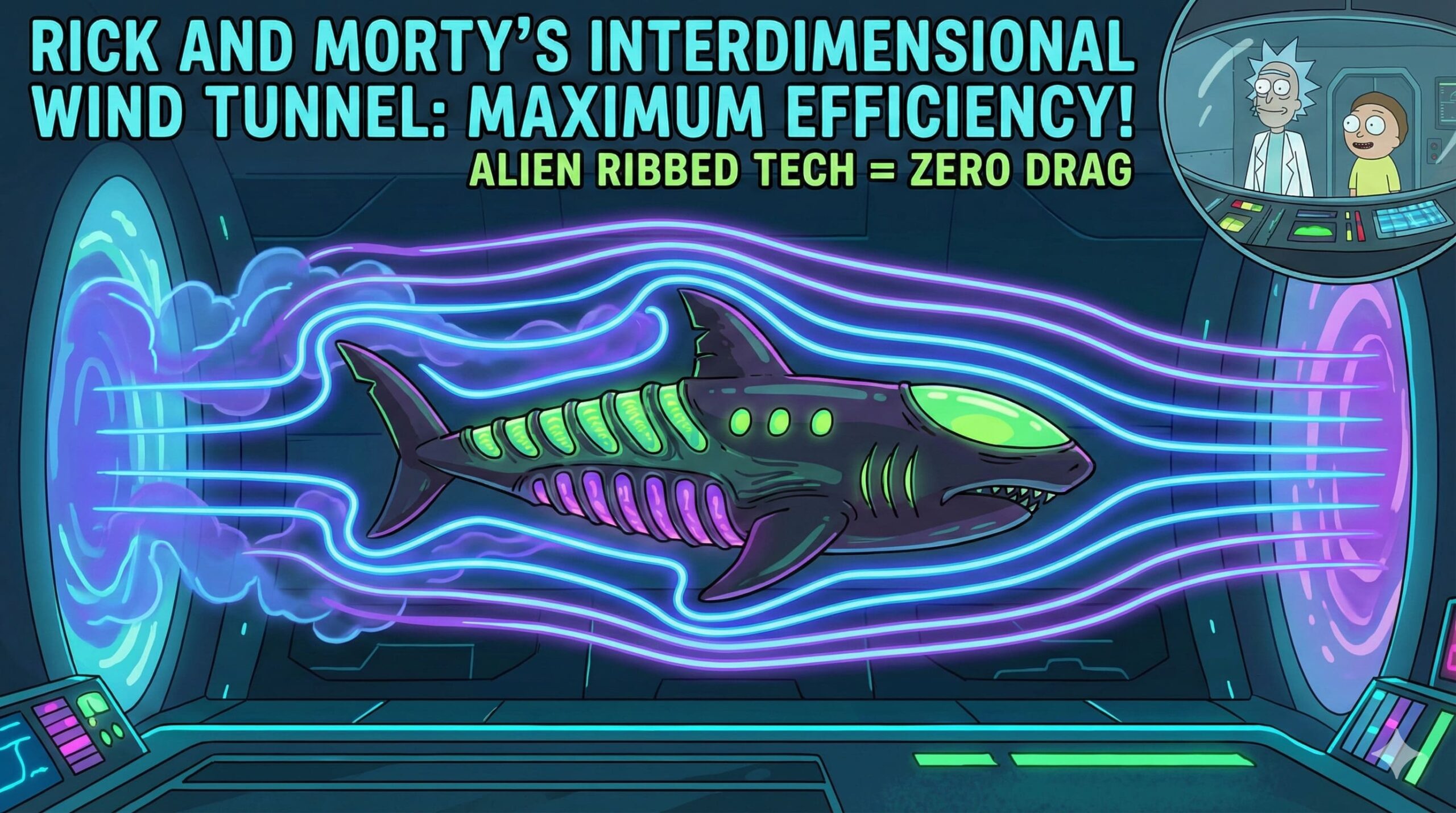
The Shark Skin Paradox: Why Rough Surfaces Make Planes Faster

If you want to build a fast car, you make it smooth. You polish the metal, hide the door handles, and wax the paint.
Intuition tells us: Smoothness = Speed. Friction is the enemy, and roughness creates friction.
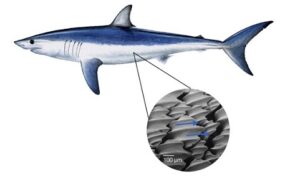
So, why is the Shortfin Mako Shark (the fastest shark in the ocean) capable of reaching 45 mph, covered in sandpaper?
If you stroke a shark from head to tail, it is smooth. But if you stroke it from tail to head, it feels like a file. It is covered in millions of microscopic teeth called Denticles.
Mathematically, this makes no sense. These jagged teeth should create massive drag, slowing the shark down.
Yet, in 2024, Lufthansa began pasting “Shark Skin” stickers (AeroSHARK) onto the bellies of their Boeing 777 jets to save fuel.
It turns out, for the last 100 years, our intuition about aerodynamics has been half-wrong. Sometimes, to go faster, you have to break the air.
The Physics: The “Stuck” Air
To understand why the Shark works, we have to look at the microscopic layer of air touching the object, known as The Boundary Layer.
When a plane flies at 500 mph, the air touching the metal wing isn’t moving at 500 mph. Due to friction, the molecules touching the wing are actually stuck (0 mph).
This creates a gradient:
- Surface: 0 mph
- 1mm up: 100 mph
- 10mm up: 500 mph (Free stream)
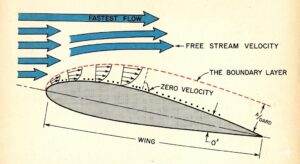
Wing Surface & Flow Labels
The Laminar Trap
Ideally, we want this layer to be smooth (Laminar). But Laminar flow is fragile. It is “lazy.” Because the air near the surface is moving slowly, it has no energy. When the wing curves or the pressure changes, this lazy air gives up. It detaches from the wing.
Separation = Vacuum
When the air separates, it creates a vacuum (low pressure) behind the object. This vacuum sucks the object backward. This is called Pressure Drag.
Pressure Drag is the killer. It is 10x stronger than the friction of the surface.
The Golf Ball Solution
This is why Golf Balls have dimples. The dimples create mini-turbulence. They mix the fast air (top) with the slow air (bottom), “energizing” the boundary layer.
- Smooth Ball: Air separates early. Large Vacuum. Distance: 150 yards.
- Dimpled Ball: Energetic air hugs the ball longer. Small Vacuum. Distance: 300 yards.
We trade a little bit of Friction (bad) to delete a huge amount of Pressure Drag (good).
The History: Why We Failed in the 80s
So, if Sharks and Golf Balls figured this out millions of years ago, why are planes still smooth?
We actually tried this before. In the 1980s, 3M created a “Riblet Tape” (vinyl with microscopic grooves) and stuck it on an experimental Airbus. It worked. It saved fuel.
But then they flew it in the real world.
The “Dirt” Problem
Real air isn’t a computer simulation. It has dust, pollen, and flies.
The microscopic grooves filled up with dirt. Within a few weeks, the “Shark Skin” became smooth again but a heavy, dirty smooth. It added weight without adding benefits. Airlines stripped it off.
The Comeback (2022)
Material Science finally caught up. Companies like Lufthansa Technik and MicroAero developed new polymers using “Nanostructuring.”
Oleophobic: The texture repels oil and dirt (like a lotus leaf).
UV Curable: It is hardened with light to be durable enough to survive 500 mph winds for 5 years.
Sharkskin Riblet Film (Biomimicry)
But we still had one problem left: Optimization.
A shark is flexible. A plane is rigid. You can’t just copy-paste the shark’s scales onto a metal tube and hope it works. You need to design for shape as well as a specific texture for every inch of the fuselage.
The Math Wall: Navier-Stokes
Designing these textures is mathematically impossible for humans.
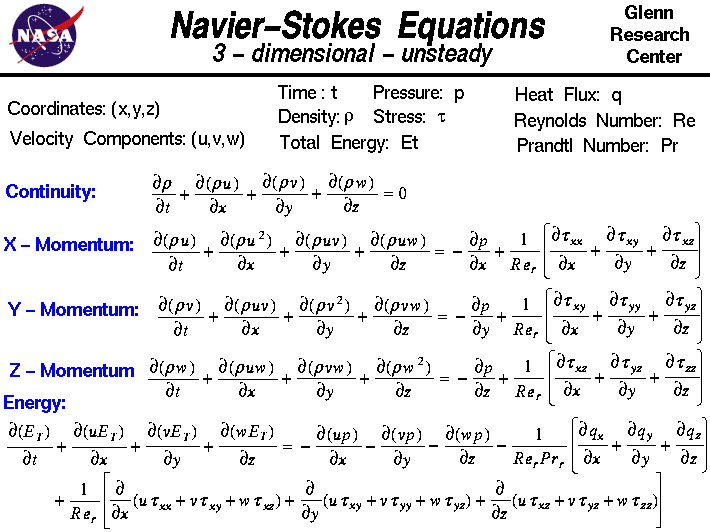
Fluid dynamics is governed by the Navier-Stokes Equations. These are non-linear partial differential equations that are so difficult, the Clay Mathematics Institute offers a $1,000,000 Prize to anyone who can prove they always have a solution.
The Simulation Limit
To simulate airflow over a single Shark Denticle (0.2mm) using Direct Numerical Simulation (DNS) takes hours on a supercomputer.
To simulate the airflow over an entire Boeing 777 covered in billions of different denticles would take longer than the age of the universe.
We hit the “Bin Packing” wall again. The perfect texture can’t be calculated. Guesswork takes over. For decades, we guessed “straight grooves” (Riblets). But AI doesn’t guess. It hallucinates.
The AI Frontier: Inverse Design
Researchers at MIT and NASA are now using Physics-Informed Neural Networks (PINNs) to solve this. Instead of running a heavy simulation (CFD) for every texture, they teach an AI the rules of physics.
They don’t ask: “How much drag does this Shark Skin have?” (Analysis). They ask: “Here is a wing. Dream up a texture that has Zero drag.” (Inverse Design).
The “Alien” Textures
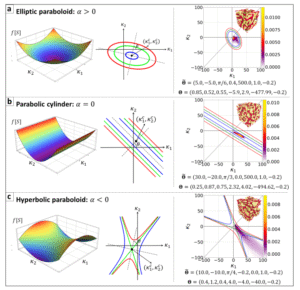
The AI is coming up with geometries that look like alien hieroglyphs; complex, non repeating patterns that change shape across the wing.
- Near the nose of the plane, the texture is smooth.
- Mid-wing, it creates tiny “ramps” to energize the air.
- Near the tail, it creates “scales” to manage the wake.
This is Generative Design. It is the same tech used to generate AI Art (Midjourney), but instead of optimizing for “beauty,” it optimizes for “Laminar Flow.”
We are moving from Biomimicry (Copying Nature) to Bio-Improvement (Correcting Nature). The Shark is fast, but the Shark didn’t have a GPU.
Embracing the Imperfection
We are taught that “perfection” looks like a polished mirror — scrubbed, shining, flawless. Our instinct is to smooth every surface, assuming any imperfection must be a defect. But the physical world doesn’t reward polish; it rewards understanding.
But the physical world is messy. Air is sticky. Water is chaotic.
The Shark, the Golf Ball, and the AI teach us that you cannot defeat chaos by ignoring it. You have to invite it in.
By accepting a little bit of roughness, a few dents, scratches, and grooves, we can slip through the world with less resistance.
It is a lesson that applies to aerodynamics as much as it does to life: Sometimes, the fastest way forward is a little bit rough.
Know more about relevant topics:
The “Tetris” Paradox: Why Nature is Better at Packing than Math:
The “Tetris” Paradox: Why Nature is Better at Packing than Math